Migration completed. Over the last few days, Lolli Group successfully completed the migration of a production FileMaker Server environment and a set of supporting WordPress and PHP websites from previous providers (AWS and SiteGround) to Hetzner Cloud.
The objective was clear and measurable: reduce recurring infrastructure costs, increase operational control, and reinvest budget into ERP development instead of continuously feeding hosting layers that add little or no real value to business operations.
This article documents the full journey: the technical analysis, the architectural decisions, the execution phase, and the concrete financial outcome. It is intentionally written to be practical, transparent, and repeatable, especially for organizations that rely on FileMaker as the core of their ERP ecosystem.
Why this migration matters for FileMaker-based ERP systems
At Lolli Group, FileMaker is not treated as a simple database engine, but as a strategic ERP platform used to manage complex workflows, sensitive data, and long-term operational growth.
We design, host, and maintain solutions ranging from small departmental systems to very large vertical platforms such as:
- LollyMed for clinics and healthcare organizations
- LollyMap and LollyPet for veterinary clinics, animal shelters, and rescue networks
- Starnet and other custom ERP solutions for industrial and service-oriented companies
These systems manage large FileMaker files, high transaction volumes, and continuously growing datasets. Infrastructure choices directly affect performance, stability, backup strategy, and long-term sustainability.
Why the comparison focuses on a single FileMaker Server
To keep the cost analysis clear, readable, and genuinely useful, this comparison intentionally focuses on one FileMaker Server only.
This is a methodological choice, not a technical limitation. Lolli Group manages multiple FileMaker Server environments for different clients and projects, often with more complex and distributed architectures.
Including all of them would obscure the message and reduce the value of the analysis for companies trying to evaluate their own situation.
By focusing on one representative production server, we provide a realistic reference model for:
- mid-sized companies using FileMaker as their ERP backbone
- healthcare and clinical environments
- veterinary clinics and animal shelters
- organizations with steadily growing data volumes
This scenario closely matches the conditions faced by many companies that need reliability and scalability without wasting budget on oversized or inefficient hosting plans.
The same transparency principle applied to web hosting
The same analytical rigor was applied to the web hosting side.
On SiteGround, multiple websites and domains were present. For this comparison, only the subset directly related to the ERP ecosystem was considered: WordPress and PHP websites that actively support FileMaker workflows.
These sites typically provide:
- public presentation pages for vertical ERP products
- landing pages and lead-generation forms
- client portals and service pages
- integration endpoints and lightweight APIs
They are not generic marketing websites, but operational extensions of the ERP infrastructure. Optimizing their hosting directly improves reliability and reduces unnecessary recurring costs.
Infrastructure before: AWS and SiteGround
Before the migration, the infrastructure was split across multiple providers:
- A FileMaker Server environment hosted on AWS-based infrastructure
- Several supporting WordPress and PHP sites hosted on SiteGround (GrowBig plan)
While technically functional, this setup introduced several long-term issues:
- high recurring monthly costs
- limited control over backup retention policies
- storage inefficiencies due to duplicated backups
- fragmented management across multiple providers
Over time, a significant portion of the IT budget was being absorbed by infrastructure instead of being invested in ERP evolution and feature development.
Infrastructure after: Hetzner Cloud
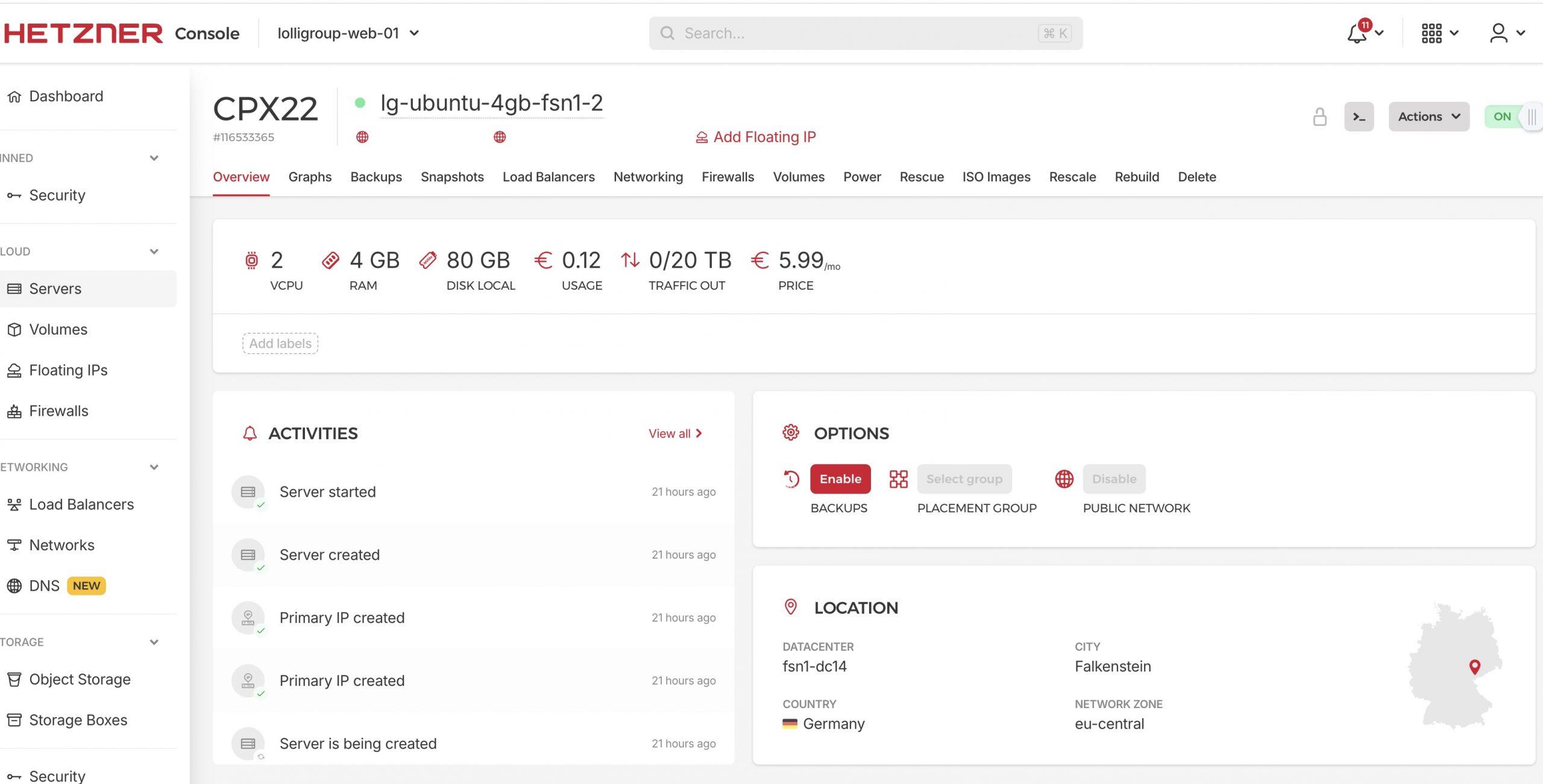
The new architecture is intentionally simple, controlled, and predictable.
For the purpose of this case study, it includes:
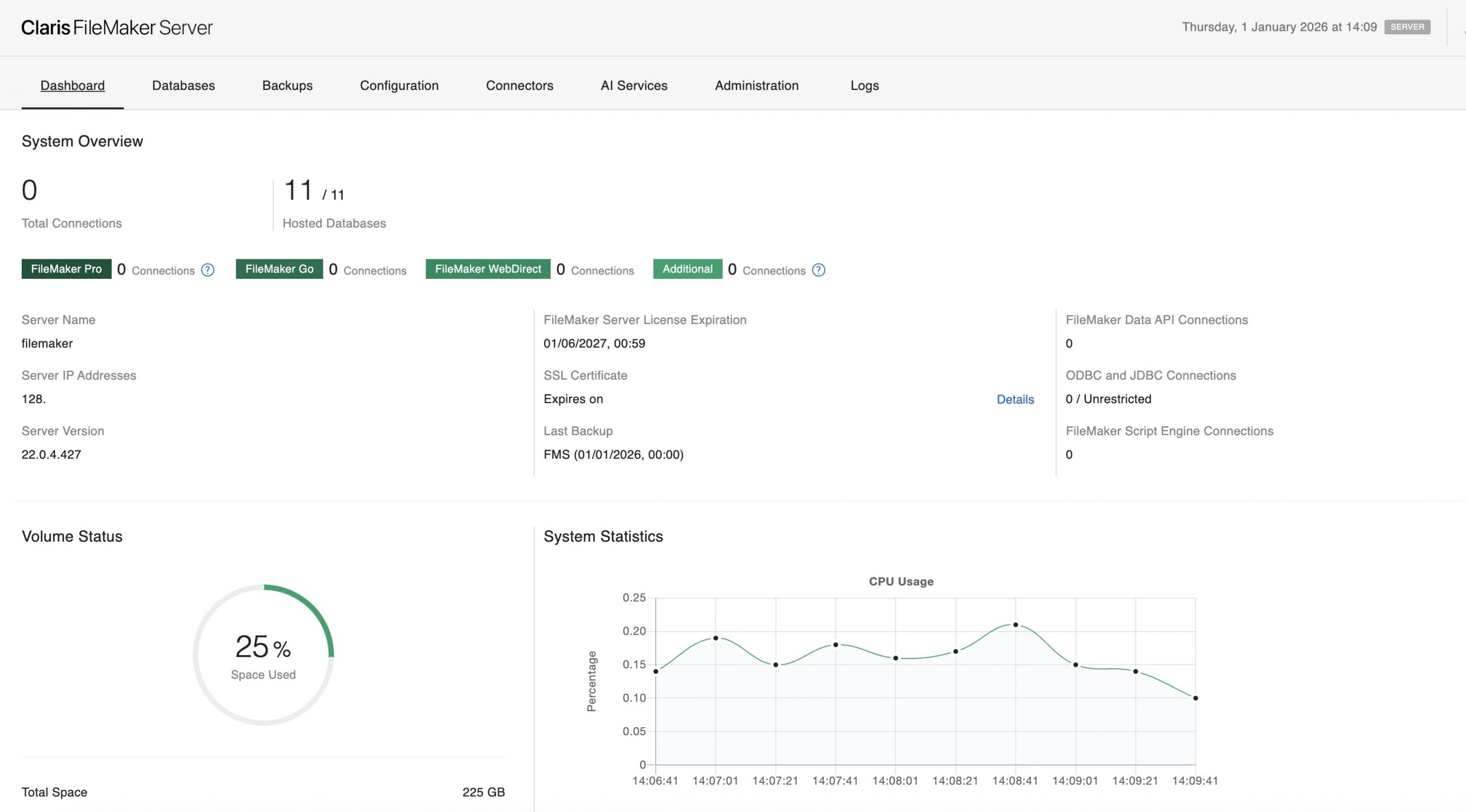
- One FileMaker Server hosted on Hetzner Cloud with high-performance local SSD storage
- One Linux server dedicated to WordPress and PHP applications supporting the ERP ecosystem
This setup delivers:
- clear cost structure
- full control over backups and retention policies
- improved disk usage efficiency
- simplified maintenance and monitoring
Most importantly, it aligns infrastructure spending with actual business needs.
Backup strategy and storage optimization
A critical part of the migration involved a deep audit of disk usage.
We identified and removed:
- obsolete on-demand FileMaker backups
- duplicated backup directories
- unused installation files and archives
Only the necessary automated backups were retained, with a clear retention policy. This alone recovered tens of gigabytes of disk space while improving backup clarity and reliability.
The result is a system where storage growth is predictable, controlled, and aligned with data growth, not accidental duplication.
Cost impact and long-term savings
By migrating from AWS and SiteGround to Hetzner Cloud, the monthly infrastructure cost was significantly reduced.
While exact numbers vary depending on configuration, the overall result is a substantial and recurring cost reduction, without sacrificing performance or security.
This freed budget can now be reinvested into:
- ERP feature development
- performance optimization
- client-specific customizations
- long-term platform scalability
This is the same decision many mid-sized companies face: invest in business value, not in unnecessary infrastructure overhead.
A model for medium-sized companies
This migration represents a realistic scenario for a medium-sized organization:
- one central FileMaker Server
- a limited number of supporting websites
- growing data volumes
- need for cost control without compromising reliability
Lolli Group completed this migration not as a theoretical exercise, but as a production-level operation designed to deliver better service to its clients — whether they run small FileMaker files or large ERP platforms.
Final considerations
This case study demonstrates that infrastructure optimization is not about cutting corners, but about making informed decisions.
By analyzing real usage patterns, eliminating waste, and choosing the right hosting model, it is possible to:
- reduce costs
- increase control
- improve long-term sustainability
At Lolli Group, this approach allows us to support both small and large FileMaker solutions with the same level of care, precision, and long-term vision.