Is your business ready for the new challenges in FileMaker maintenance as 2026 approaches? Outdated support can quietly put your mission-critical systems at serious risk, leading to costly downtime and compliance issues.
This essential guide walks you through every aspect of a filemaker maintenance contract for 2026. You’ll learn how to ensure top performance, reliable support, and the best value for your investment.
Discover what’s changed, what to demand in your contract, how to stay compliant, and the smartest ways to select and negotiate with vendors.
The Evolving Landscape of FileMaker Maintenance in 2026
Is your organization ready for the rapid changes in FileMaker technology? The environment for any filemaker maintenance contract is evolving quickly, and staying ahead is essential if you want to safeguard your mission-critical systems. Let’s explore what’s changing, what the numbers reveal, and how real businesses are adapting to the future of FileMaker maintenance.

Key Changes in FileMaker Technology and Support
The filemaker maintenance contract landscape is changing faster than ever before. Claris FileMaker’s roadmap through 2026 introduces a wave of innovations that will directly impact how companies structure their maintenance agreements.
First, the surge in cloud migration and hybrid deployments means organizations are no longer tethered to on-premise setups. Maintenance contracts must now address new challenges like data synchronization, uptime in the cloud, and seamless integration between cloud and local resources.
APIs and third-party services are taking center stage. Modern filemaker maintenance contract terms need to include support for API-driven workflows, ERP integrations, and even IoT devices. The rise of AI-driven automation is also reshaping how businesses use FileMaker, requiring support for custom scripts, machine learning add-ons, and advanced analytics.
Security and compliance have become non-negotiable. With stricter data privacy laws and the growing threat landscape, maintenance contracts must specify responsibilities around security patching, vulnerability management, and compliance audits. Multi-site operations and remote workforces add complexity, making it crucial for support terms to cover remote user access, site-to-site data transfer, and incident response protocols.
If your business is planning to modernize or optimize its FileMaker system, it’s worth reviewing Updating and modernizing FileMaker applications as part of preparing your next filemaker maintenance contract.
Industry Trends and Benchmarks
Industry data shows that more than 65% of organizations are shifting to cloud-based FileMaker solutions by 2026, according to recent reports. This trend is influencing both the structure and length of the average filemaker maintenance contract, with most businesses opting for annual or biannual renewals.
Here’s a quick snapshot of 2025–2026 benchmarks:
| Trend | Statistic/Benchmark |
|---|---|
| Cloud Adoption | 65%+ by 2026 |
| Average Renewal Period | 12–24 months |
| Common Pain Points | Downtime, slow response, API failures |
Downtime and integration failures remain top concerns, making fast response times and robust escalation paths critical in every filemaker maintenance contract.
Examples
Let’s look at how these changes play out in real scenarios. A healthcare provider recently moved to a cloud-based FileMaker environment, which required a new filemaker maintenance contract with enhanced SLAs for uptime and compliance with HIPAA regulations.
Meanwhile, a manufacturing company integrated IoT devices using FileMaker APIs. Their filemaker maintenance contract had to include specialized support terms for API troubleshooting and 24/7 monitoring to keep critical operations running smoothly.
These examples highlight why it’s essential to review and update your filemaker maintenance contract to match today’s technology and tomorrow’s expectations.
Core Components of a FileMaker Maintenance Contract
A robust filemaker maintenance contract is the backbone of long-term system health and business continuity. Understanding what to include in your agreement can make the difference between smooth operations and costly disruptions. Below, we break down the must-have components every organization should demand in 2026.
Essential Service Inclusions
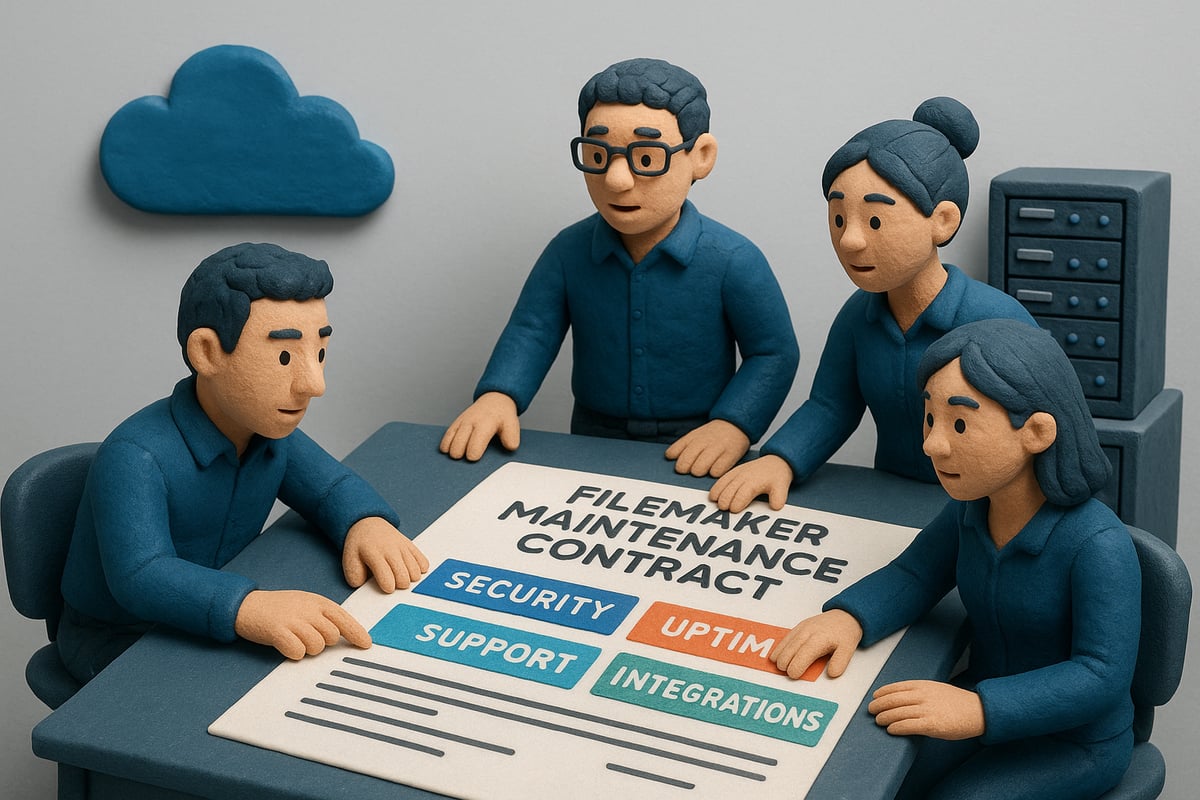
Every filemaker maintenance contract should clearly outline the scope of services provided. At a minimum, expect:
- Proactive monitoring of systems and regular health checks
- Bug fixes and troubleshooting for reported issues
- Performance optimization to ensure peak operation
- Update and upgrade management for new FileMaker releases
- Defined response times for incidents, categorized as critical, major, or minor
- Support hours, with options for standard business hours or 24/7 assistance
- Onsite and remote support clauses, depending on your needs
- Data backup and recovery provisions to safeguard information
Without these inclusions, your filemaker maintenance contract may leave gaps that put your business at risk. Review each area carefully to align with your operational requirements.
Security and Compliance Clauses
Modern filemaker maintenance contracts must address a growing landscape of regulations and threats. Essential clauses should cover:
- Adherence to GDPR, HIPAA, or industry-specific standards
- Regular security patching and vulnerability management
- Audit and reporting requirements to demonstrate compliance
- Encryption protocols for data at rest and in transit
- Access controls restricting system changes to authorized personnel
For organizations handling sensitive data, referencing official guidelines like those found in Comply with regulatory requirements ensures your filemaker maintenance contract meets necessary standards. This builds trust with clients and regulators alike.
Performance and Availability Guarantees
A filemaker maintenance contract is only as strong as its commitment to performance. Your agreement should specify:
- Uptime guarantees, commonly 99.9% or higher
- Remedies for missed SLAs, such as service credits or escalation rights
- Clear definitions for incident severity and response targets
Here's a sample table summarizing typical SLA benchmarks:
| Incident Type | Target Response Time | Resolution Benchmark |
|---|---|---|
| Critical | 4 hours | 24 hours |
| Major | 8 hours | 48 hours |
| Minor | 24 hours | 5 business days |
Setting these standards in your filemaker maintenance contract provides accountability and measurable results.
Customization and Integration Support
Most organizations rely on custom scripts, API integrations, and third-party add-ons to extend FileMaker's capabilities. Your filemaker maintenance contract should address:
- Support for custom code and business logic
- Integration assistance with ERP, CRM, or IoT platforms
- Ongoing compatibility testing for new FileMaker releases
- Provisions for AI or automation enhancements
Without explicit language, you may discover support gaps when you need help most. Make sure your filemaker maintenance contract covers all customizations and integrations powering your workflows.
Example Clauses and Benchmarks
To help you draft a strong filemaker maintenance contract, consider these sample SLA clauses and industry benchmarks:
**Sample SLA Language:**
"Vendor shall respond to all critical incidents within four (4) hours, with a target resolution within twenty-four (24) hours. Uptime shall not fall below 99.9% in any calendar month."
Industry averages show 4-hour response times for critical issues and 99.9% uptime as the standard. Use these benchmarks to evaluate proposals and negotiate terms. A well-structured filemaker maintenance contract sets clear expectations and paves the way for successful partnerships.
Steps to Draft and Evaluate a FileMaker Maintenance Contract
Drafting and evaluating a filemaker maintenance contract for 2026 is not just a formality—it is the backbone of your system's reliability. A methodical approach ensures you cover all bases, from technical needs to legal protections. Let us break down each step so you can confidently secure the right contract for your business.

Step 1: Assess Your FileMaker Environment and Needs
Begin by taking inventory of your current FileMaker setup. List all customizations, integrations, and workflows that are mission-critical. This clarity will help you define what your filemaker maintenance contract must cover.
- Identify integrations with third-party applications or APIs.
- Note custom scripts, triggers, and automations.
- Highlight periods of peak activity or high-risk operations.
Documenting these details ensures you do not overlook essential support or backup requirements. The more precisely you define your environment, the stronger your contract foundation becomes.
Step 2: Define Service Requirements and KPIs
With your environment mapped, outline specific service needs for your filemaker maintenance contract. Focus on measurable KPIs to guarantee accountability.
- Set uptime targets, such as 99.9% system availability.
- Define response and resolution times for various incident types.
- Specify compliance requirements, like GDPR or HIPAA adherence.
- Detail reporting needs, including frequency and format.
Clear KPIs help both parties align expectations, reducing the risk of miscommunication down the line.
Step 3: Research and Shortlist Qualified Vendors
Selecting the right partner is crucial for a successful filemaker maintenance contract. Investigate vendors’ technical expertise, certifications, and track records in your industry.
- Review client case studies and testimonials.
- Confirm experience with cloud, API, and AI-enabled FileMaker environments.
- Check for support infrastructure, such as 24/7 help desks or dedicated account managers.
For European businesses, consider exploring FileMaker consulting services Europe to find specialists attuned to regional compliance and support standards. Shortlisting vendors with proven success will save you time and headaches later.
Step 4: Request and Analyze Proposals
Request detailed proposals from your shortlisted vendors. Scrutinize each filemaker maintenance contract template to ensure transparency and alignment with your needs.
- Compare service descriptions and included features.
- Evaluate pricing models: fixed, tiered, or usage-based.
- Look for clarity on escalation procedures and support boundaries.
A side-by-side comparison table can make this process easier:
| Vendor | Support Hours | SLA Uptime | Response Time | Pricing Model |
|---|---|---|---|---|
| Vendor A | 24/7 | 99.9% | 2 hours | Fixed |
| Vendor B | 9-5 | 99.5% | 4 hours | Tiered |
This approach helps you spot value and potential gaps quickly.
Step 5: Negotiate Terms and Finalize the Agreement
Negotiation is your chance to tailor the filemaker maintenance contract to your unique requirements. Focus on terms that directly impact your business continuity and risk management.
- Prioritize critical SLAs and escalation paths.
- Clarify exit, renewal, and change management clauses.
- Request regular contract reviews and performance assessments.
Do not hesitate to negotiate for flexible terms if your business expects rapid growth or technological change. Finalize the agreement only when you are confident all your needs are addressed.
Example: Checklist for Evaluating Proposals
Use this checklist to objectively rate each filemaker maintenance contract proposal:
- Vendor responsiveness and communication
- Technical depth and relevant certifications
- Transparency in pricing and service scope
- Explicit SLAs and escalation procedures
- Clear compliance and security provisions
- Absence of hidden fees or vague clauses
A systematic review process like this ensures you choose a partner who can support your mission-critical systems, now and into 2026.
Compliance, Security, and Legal Considerations
Safeguarding your business with a robust filemaker maintenance contract is non-negotiable in 2026. The regulatory landscape is shifting, and overlooking compliance, security, or legal terms could expose you to operational and reputational risks. Let’s break down what you need to know to keep your systems secure and your contracts watertight.
Regulatory Requirements for FileMaker Environments
Navigating the regulatory maze is critical when drafting your filemaker maintenance contract. In 2026, data protection standards like GDPR and HIPAA remain front and center, but new privacy frameworks are also emerging worldwide. Your contract should clearly define how data is handled, stored, and transferred to meet these evolving requirements.
Include clauses specifying vendor responsibility for data privacy, especially if sensitive or regulated information is processed through your FileMaker systems. Ensure that the filemaker maintenance contract mandates regular compliance reviews and requires the vendor to keep pace with updates in the law. This proactive approach reduces your risk of non-compliance penalties and helps maintain customer trust.
Security Provisions in Maintenance Contracts
Security is a cornerstone of every filemaker maintenance contract. Your agreement must require strong encryption, robust access controls, and detailed audit logs to track who accesses your data and when. As threats evolve, your vendor should be obligated to provide timely security patches and vulnerability management.
Incident response plans are now a must. Ensure your contract outlines clear breach notification timelines, ideally within 72 hours. For added peace of mind, consider FileMaker Security Audit services to identify vulnerabilities before they become liabilities. Comprehensive security provisions in your filemaker maintenance contract are essential for safeguarding your business against both internal and external threats.
Legal Protections and Liabilities
A well-crafted filemaker maintenance contract shields your business from unexpected legal exposure. Look for clear limitation of liability clauses that cap your vendor’s responsibility for damages. Indemnification provisions ensure the vendor covers costs if their negligence leads to a breach or compliance failure.
Intellectual property rights and confidentiality must be spelled out in your filemaker maintenance contract. Specify who owns custom code, scripts, or integrations, and require the vendor to maintain strict confidentiality around your proprietary data. These legal safeguards help you avoid costly disputes and protect your competitive edge.
Industry Examples and Benchmarks
Industry trends highlight the rising importance of contract rigor. Recent competitor analysis shows that over 80 percent of filemaker maintenance contracts now include breach notification clauses with a 72-hour window. In healthcare, contracts increasingly require annual compliance audits and detailed reporting provisions.
A strong filemaker maintenance contract is benchmarked against these industry standards. By aligning your contract with proven best practices, you position your organization for smooth audits, fewer disputes, and better long-term value from your FileMaker investment.
Selecting the Right FileMaker Maintenance Partner
Choosing the right partner for your filemaker maintenance contract is one of the most important decisions your business will make in 2026. The wrong choice can lead to costly downtime, slow support, and unplanned expenses.
A well-chosen partner ensures your systems are always optimized, secure, and ready for future innovation. But how do you separate the best from the rest? Let’s break down what you need to look for, and how to compare your options.
Key Criteria for Vendor Selection
When evaluating candidates for your filemaker maintenance contract, start with technical expertise. Your partner should have deep knowledge of the latest FileMaker features, especially cloud, AI, and API capabilities.
Industry experience is another priority. Look for vendors who have delivered successful solutions in your field, whether it’s healthcare, manufacturing, or professional services. Ask for client references and documented case studies.
Certifications matter. A certified Claris FileMaker partner brings proven skills, ongoing training, and access to vendor resources. To understand the full range of benefits, check out the detailed Claris FileMaker partner benefits.
Support infrastructure is equally important. Ensure your vendor has a responsive helpdesk, clear escalation paths, and a track record of rapid issue resolution.
Evaluating Service Models and Pricing
The right filemaker maintenance contract isn’t just about expertise, but also the service model. Fixed-fee agreements offer predictable costs, ideal for stable environments and tight budgets.
Pay-as-you-go models give flexibility, allowing you to scale support up or down as your needs shift. This can be useful for businesses with seasonal peaks or frequent system changes.
Transparency is critical. Insist on itemized pricing, clear definitions of included and excluded services, and no hidden fees. Ask vendors for sample invoices and detailed service descriptions before you sign.
Compare the contract renewal periods, escalation procedures, and any minimum commitments. Make sure pricing aligns with the level of support and SLAs your business demands.
Transition and Onboarding Support
Smooth onboarding is a hallmark of a strong filemaker maintenance contract. Your chosen partner should provide a structured transition plan, minimizing disruption to your operations.
This includes detailed knowledge transfer, training sessions for your team, and clear documentation of processes and customizations. Migration support is key if you're moving to cloud or hybrid deployments.
Ask about ongoing education and access to best practices. Vendors who invest in your team’s success help you get the most value from your FileMaker system over time.
Comparative Table of Top FileMaker Maintenance Providers
Use the table below as a starting point to compare providers for your filemaker maintenance contract:
| Provider | Certifications | SLA Uptime | Support Model | Industry Focus | Client Rating |
|---|---|---|---|---|---|
| Vendor A | Claris Platinum | 99.9% | Fixed, 24/7 | Healthcare | 4.8/5 |
| Vendor B | Claris Gold | 99.5% | Pay-as-you-go | Manufacturing | 4.6/5 |
| Vendor C | Claris Certified | 99.7% | Hybrid | Services | 4.7/5 |
Review these benchmarks, but always tailor your selection to your own business needs and priorities.
The right filemaker maintenance contract partner is a strategic advantage, not just a vendor. Take the time to vet your options, demand transparency, and choose a team invested in your long-term success.
Negotiation Strategies and Best Practices for 2026
Is your next filemaker maintenance contract coming up for renewal? Smart negotiation in 2026 can make the difference between a resilient, future-ready solution and a costly, restrictive agreement. Let’s break down how you can approach negotiations to secure the best value and performance for your business.
Preparing for Contract Negotiations
Start by assessing your leverage before entering any filemaker maintenance contract discussion. Consider your company’s size, the length of the contract, and the competitive landscape among vendors. Larger businesses or those committing to longer terms often have more negotiating power.
List your must-haves versus nice-to-haves. Are 24/7 support and rapid response times mission-critical? Is compliance with industry standards like GDPR or HIPAA non-negotiable? Prioritize these needs and communicate them clearly to potential partners.
A well-prepared negotiation strategy means you can confidently push for terms that support your long-term goals, not just short-term fixes. This preparation ensures your filemaker maintenance contract is built on a foundation that aligns with your business priorities.
Tactics for Securing Favorable Terms
Use a multi-pronged approach to maximize value in your filemaker maintenance contract. Bundling services—such as customization, integration, and ongoing support—can often unlock discounts and streamline vendor management. For organizations with complex ERP systems, negotiating for robust FileMaker ERP integration solutions as part of your contract can add significant long-term value.
Insist on custom service-level agreements (SLAs) tailored to your business’s uptime, response, and resolution needs. Request regular performance reviews and maintain flexibility to adjust contract terms as your technology evolves, especially as AI and API integrations become more central to your operations.
Don’t hesitate to ask for transparent reporting on all service activities. This transparency will help you hold your vendor accountable and quickly address any issues that arise in your filemaker maintenance contract.
Avoiding Common Pitfalls
Many businesses overlook critical details that can undermine their filemaker maintenance contract. Watch out for hidden costs, vague SLA definitions, and exclusions that leave you exposed during critical incidents.
Always specify clear exit and renewal terms to avoid lock-in or unexpected fees. Demand clarity on incident escalation paths, and insist on detailed compliance and security clauses. For example, including requirements for regular updates and security best practices—such as those outlined in Best Security Practices for FileMaker 2025—can safeguard your data and reputation.
A checklist approach helps you identify gaps before signing. If a vendor hesitates to provide specifics in your filemaker maintenance contract, treat it as a red flag.
Example Negotiation Scenarios
Consider a manufacturing company integrating IoT devices with FileMaker. By leveraging their scale and technical needs, they negotiated improved uptime guarantees and custom API support in their filemaker maintenance contract. This ensured seamless operations and minimized costly downtime.
Recent industry data shows that nearly 40% of businesses renegotiated their filemaker maintenance contract in 2025–2026 to secure better AI support and integration flexibility. This trend highlights the growing expectation for vendors to adapt quickly to emerging technologies.
Successful negotiation is not about confrontation—it’s about building a partnership that aligns with your vision and growth. By advocating for your needs and staying informed, you can turn your filemaker maintenance contract into a catalyst for innovation and stability.
Partnering with a Certified FileMaker Specialist: The Lolli Group Advantage
Choosing the right partner for your filemaker maintenance contract is essential to protecting your business-critical systems. Certified Claris FileMaker specialists bring proven expertise, helping you avoid costly downtime and compliance headaches.
The Lolli Group stands out as a trusted partner for organizations that demand more from their filemaker maintenance contract. Their team delivers:
- Custom ERP and CRM solutions tailored to unique business processes.
- Seamless API integrations with third-party systems for enhanced efficiency.
- Advanced AI-driven enhancements that automate workflows and boost productivity.
Flexibility and scalability matter more than ever. Lolli Group adapts maintenance strategies as your FileMaker environment grows, ensuring your filemaker maintenance contract always matches your evolving needs. They prioritize strict compliance, making regulatory requirements like GDPR and HIPAA straightforward to achieve.
Industries served include healthcare, manufacturing, and professional services. Clients benefit from:
- Rapid response and proactive support.
- Tailored solutions that fit current and future goals.
- Continuous system improvements that keep your business competitive.
Ready to future-proof your FileMaker investment? Contact the Lolli Group today to request a tailored FileMaker maintenance proposal designed for your business.