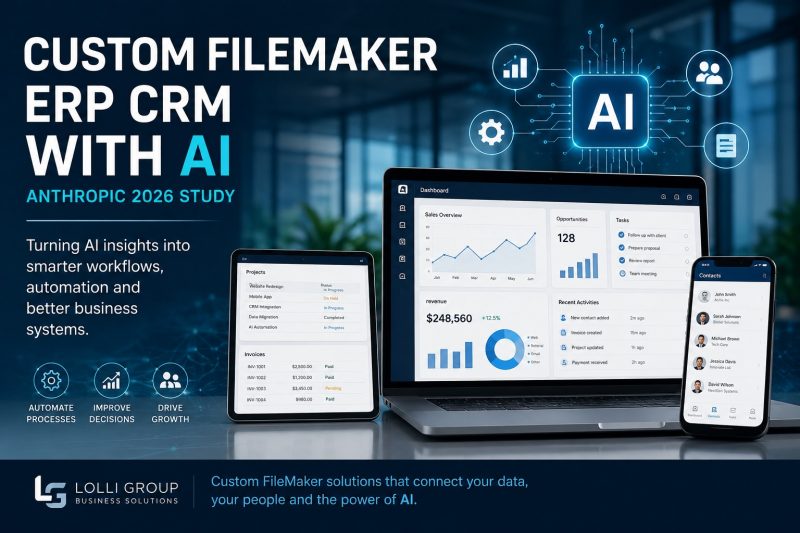
Custom FileMaker ERP CRM with AI: Anthropic 2026 Study
Custom FileMaker ERP CRM with AI is becoming a practical way for businesses to turn artificial intelligence into real operational value. Anthropic’s newly published Anthropic Economic Index report: Cadences shows that AI is no longer just a tool for quick answers. It is increasingly part of daily work, business workflows, reporting, analysis, writing, and decision support.
For many companies, a custom FileMaker ERP CRM with AI is becoming the most practical way to connect data, workflows, automation, and human decision-making in one system.
This is exactly why generic software stacks are starting to show their limits. Businesses increasingly need custom ERP and CRM systems that can connect data, workflows, people, and AI in one controlled environment. This is where Lolli Group, through tailored Claris FileMaker solutions, can create a real competitive advantage.
Anthropic’s 2026 findings: AI is becoming part of the workday itself
Anthropic’s report shows that AI usage now mirrors the real cadence of economic life. Work-related activity follows the workweek, personal usage rises on weekends, and highly specific behaviors appear at precise times of day. News-related prompts tend to peak in the morning, business correspondence follows office hours, recipe requests rise in the evening, and tax-related conversations surge around deadlines.
This matters because it confirms something many companies still underestimate: AI is not being adopted in isolation. It is being woven directly into the timing, pressure, and operational rhythm of real organizations.
In other words, AI is becoming part of the workflow itself, not just an external assistant.
That is also why disconnected tools create friction. If employees are using AI to draft emails, summarize reports, analyze data, prepare plans, generate code, and support decision-making, but company information is spread across spreadsheets, emails, legacy databases, and separate SaaS platforms, productivity gains are capped.
A custom Claris FileMaker ERP or CRM changes that equation. Instead of forcing teams to jump between tools, it centralizes the business logic and creates a structured layer where AI can operate on real company data in a useful, controlled, and auditable way.
AI is producing real business artifacts, not just chat responses
One of the most important insights in the Anthropic study is that AI conversations increasingly produce concrete outputs. Anthropic classifies these as artifacts such as explanations, documents and reports, guidance, analyses and summaries, emails, apps, websites, plans, scripts, code fixes, charts, and data-related outputs.
That shift is crucial for SEO, digital operations, and management strategy, because it moves AI from “answer engine” to “production layer.” Businesses are not only asking AI questions. They are using AI to create deliverables.
For example, teams now use AI to:
- draft internal and external communications,
- prepare reports and summaries,
- analyze operational data,
- generate workflow documentation,
- build software components,
- support planning and strategy.
This is where FileMaker and Claris-based business applications become especially valuable. A custom platform built by Lolli Group can turn AI-generated output into structured action. Instead of generating a disconnected report, AI can help populate a CRM record, trigger a workflow, enrich a customer profile, draft a sales follow-up, classify documents, or assist an ERP process in real time.
That is the difference between using AI as a toy and using AI as infrastructure.
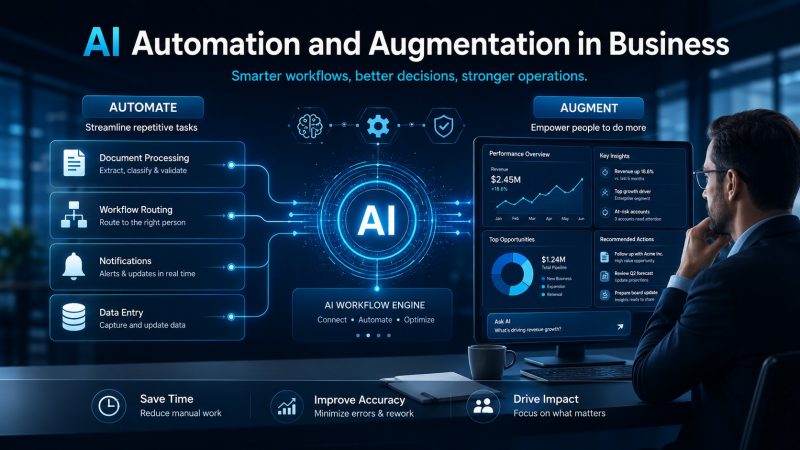
Automation is rising, but augmentation remains the winning model
There is a lot of noise online about AI replacing jobs entirely. Anthropic’s report paints a more nuanced picture.
Yes, people increasingly expect AI to do a larger share of their work in the next 12 months. More than a third of surveyed respondents expect AI to be able to do most or nearly all of their work tasks next year. At the same time, the report also shows that many of the highest-value use cases still look more like augmentation than full replacement.
Anthropic found that higher-value work tends to involve:
- more compute,
- more interaction,
- more back-and-forth between human and AI,
- and more sophisticated outputs.
That is a critical business lesson. The future is not simply “AI does everything.” The future is that the most competitive companies will combine human judgment + structured systems + AI acceleration.
This is exactly the philosophy behind a well-designed custom ERP CRM in Claris FileMaker. The system should not remove humans from the loop where judgment matters. It should remove repetition, fragmentation, manual duplication, and low-value administrative work.
With the right FileMaker architecture, AI can support users while management keeps visibility, rules, permissions, and traceability.
Why AI needs structured company data to be useful
Many businesses want to “use AI,” but the real question is this: where will the AI get the right context from?
If customer information is incomplete, if operations are tracked manually, if processes live in email chains, and if reporting is done with disconnected spreadsheets, AI can only produce superficial output.
To generate real value, AI needs access to structured and relevant information such as:
- customer records,
- sales history,
- project status,
- inventory and logistics data,
- documents and correspondence,
- financial and operational workflows.
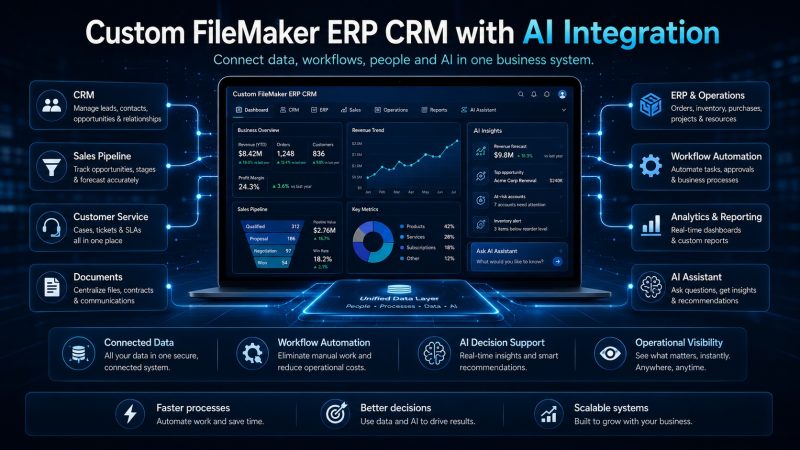
This is why custom Claris FileMaker systems are more relevant than ever. FileMaker is not just a database platform. In the right hands, it becomes a business operations hub that connects people, processes, data sources, and external APIs.
At Lolli Group, we build personalized ERP and CRM systems designed around the real workflow of each company. That means AI can be integrated in ways that are practical and immediately useful:
- AI-assisted quoting and proposal generation,
- automatic document summarization,
- email drafting from CRM context,
- support for customer service teams,
- classification of incoming requests,
- workflow suggestions based on record status,
- knowledge retrieval from company documents,
- AI-enhanced dashboards and decision support.
The companies that win will not just adopt AI, they will operationalize it
Anthropic’s study shows that AI is already embedded in real work outputs such as reports, emails, plans, software, documents, data tasks, and business content. That means the competitive gap will not only come from “using AI sometimes.” It will come from how deeply AI is embedded into everyday execution.
The companies that benefit most will be the ones that operationalize AI through systems, not scattered experiments.
That includes:
- clear workflows,
- centralized data models,
- role-based permissions,
- custom dashboards,
- automations linked to business events,
- and AI access to high-quality contextual data.
A business that runs on a tailored Claris FileMaker ERP is in a much stronger position than one relying on generic tools that do not reflect its real processes.
This is one of the reasons why Lolli Group works on custom ERP CRM development for structured small, medium, and large businesses. Off-the-shelf software often forces teams to adapt to the software. A personalized FileMaker solution does the opposite: it adapts the software to the business and then makes AI integration far more effective.
What Anthropic’s survey says about jobs, skills, and optimism
Another fascinating part of the report is the human side. Anthropic found that people who use AI in more automated ways are not necessarily the most pessimistic. In fact, they often report more positive expectations around pay, job security, and future opportunity.
The survey also found strong reported gains in speed, scope, and quality of work. Many respondents said AI helps them learn more, and a majority said it makes their skills more valuable.
This is a very important signal for business leaders.
The practical question is no longer whether AI will affect work. It already is. The real question is whether your organization will use AI in a way that:
- improves output quality,
- reduces wasted time,
- preserves human expertise,
- and strengthens the long-term value of your team.
A properly designed FileMaker custom CRM or ERP helps make that possible because it creates the foundation for assisted work, not chaotic work. Teams stay in control. Data remains structured. AI becomes a collaborator inside the system instead of an uncontrolled external layer.
Why a custom FileMaker ERP CRM with AI is ideal for modern businesses
There is a reason many businesses are returning to custom platforms after years of SaaS fragmentation. They want speed, flexibility, ownership, and real alignment with operations.
Claris FileMaker is especially powerful for organizations that need to move quickly while keeping business logic under control. It allows the creation of tailored applications for sales, service, production, administration, compliance, logistics, and management reporting.
When combined with AI, a custom FileMaker solution can become the core of an intelligent operating system for the company.
At Lolli Group, this means designing systems that can:
- connect internal databases and external services,
- integrate AI models and automation workflows,
- reduce repetitive administrative effort,
- improve CRM quality and customer follow-up,
- support ERP processes with better data visibility,
- and generate measurable productivity gains.
In practical terms, a custom Claris FileMaker ERP CRM can help a company move from disconnected operations to AI-supported execution without losing control of process quality or governance.
From hype to execution: the real AI opportunity for business
The biggest takeaway from Anthropic’s latest work is not that AI is “coming.” It is already part of the work economy, already shaping outputs, already changing expectations, and already affecting how people organize tasks.
But adoption alone is not a strategy.
To turn AI into a real business advantage, companies need systems that are:
- customized to their workflow,
- connected to real operational data,
- flexible enough to evolve,
- and strong enough to support secure AI integration.
That is exactly where Lolli Group delivers value: building custom FileMaker and Claris ERP CRM systems that do not just digitize work, but prepare it for intelligent automation and AI-assisted growth.
Conclusion
Anthropic’s 2026 study confirms that AI is moving deeper into the real structure of work. It follows the workweek, produces increasingly valuable artifacts, supports both automation and augmentation, and is already changing how people think about productivity, tasks, and job evolution.
For businesses, the next step is not to chase every new AI tool. It is to build the right digital foundation.
That foundation is often a custom ERP or CRM platform built around real processes, real people, and real business goals. With Claris FileMaker and the right development partner, companies can create a system where AI is not an isolated experiment, but a practical engine for efficiency, clarity, and growth.
If your business is looking for a custom FileMaker ERP CRM with AI to improve workflows, automation, reporting, and decision support, contact Lolli Group here to discuss a tailored solution.