AI FileMaker integration is not about adding a chatbot to an existing database. It is about improving a working business system without losing control of the data, the process or the people who use it.
That is the kind of work we do at Lolli Group. We build and support custom business applications with Claris FileMaker, FileMaker Pro and FileMaker Server, then connect them to the databases, APIs and services that a real organisation needs.
Claris FileMaker is still a serious business platform
Some people still think of FileMaker as a small database used by a single department. That may describe an old implementation, but it does not describe what a well-designed Claris FileMaker solution can become.
With FileMaker Pro, FileMaker Server, layouts, portals, relationships, scripts, custom functions, JSON and the FileMaker Data API, a FileMaker application can support CRM, ERP, operations, document workflows, customer service and highly specialised internal processes.
It can also remain understandable to the people who run the business. That matters. A technically impressive system is not useful if the team cannot maintain it, explain it or adapt it when the process changes.
How we approach AI FileMaker integration
Over the last few weeks, our work has included the less visible side of software development: replacing a legacy import process, staging files in FileMaker, comparing old and new results, and reconciling data before a change reaches production.
In one workflow, FileMaker provides the operational context and the audit trail. A server-side Python process handles specialised processing. Relational data can be stored and checked in PostgreSQL or MySQL, while MongoDB is useful when the data is document-oriented or changes shape over time.
The important point is not the number of technologies. It is the boundary between them. We decide which part belongs in a FileMaker script, which part belongs in a database service, which part should use an API, and which result must be reviewed by a person.
- Claris FileMaker for layouts, portals, business rules and user workflows;
- FileMaker Server and server-side scripts for controlled execution;
- FileMaker Data API, JSON and web services for integration;
- PostgreSQL or MySQL for structured, durable data processing;
- MongoDB for flexible document data and evolving payloads;
- Python for imports, comparisons and specialised automation;
- AI for suggestions, extraction, classification and development assistance, with checks around it.
Why this is more difficult than asking AI to write code
An AI assistant can produce a FileMaker calculation or a Python function in seconds. That is useful, but it is only the beginning.
The difficult questions are usually elsewhere: What happens when an import is repeated? Which record is authoritative? Who is allowed to run the script? What should happen after a partial failure? How do we compare the legacy result with the new one? How do we prove that a change did not move or duplicate data?
Those questions require experience with FileMaker relationships, found sets, privileges, context, commits, server execution and external database behaviour. They also require people who are willing to test the real workflow instead of trusting a green status message.
Where AI helps, and where it does not
We use AI to speed up research, code review, data classification, documentation and the first draft of an automation. It is particularly useful when a FileMaker solution has to communicate with PostgreSQL, MongoDB, Python or an external API.
But AI does not know the history of a company’s data unless we give it that context. It does not automatically understand a privilege model. It cannot decide whether a suspicious record should be updated, ignored or escalated. It should not be allowed to publish a result simply because the generated code looks convincing.
Our job is to make the technology useful without pretending that it is infallible. That means validation, logs, permissions, comparison reports and human decisions at the right points in the process.
What most people do not expect from FileMaker
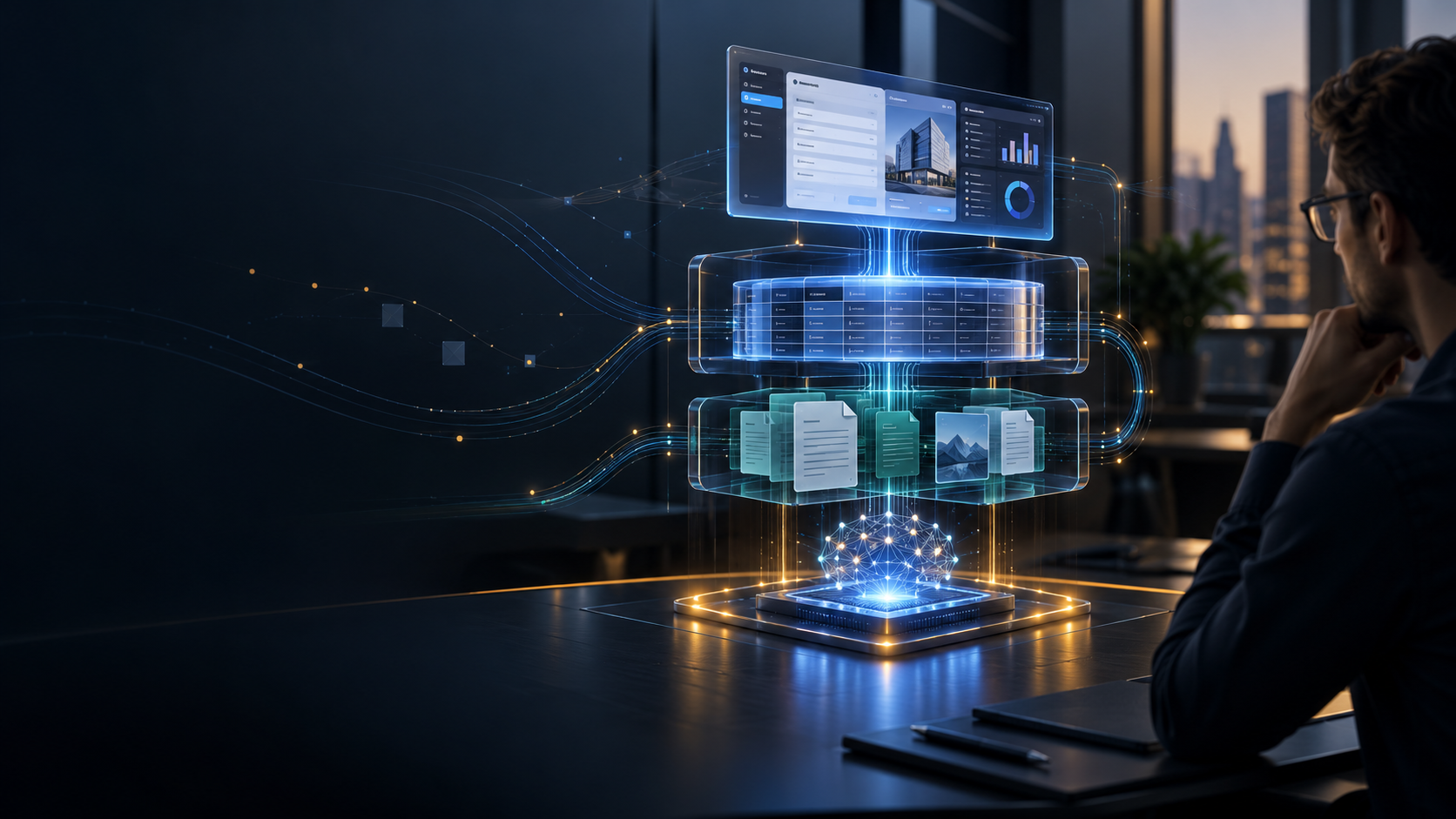
A Claris FileMaker application can be the practical front end of a wider architecture. It can coordinate an internal ERP or CRM, call APIs, exchange JSON, process containers, trigger server-side scripts, communicate with external databases and present a workflow that is tailored to a particular organisation.
This is why we do not treat FileMaker as a limitation. We treat it as a powerful application platform that needs to be connected thoughtfully to the rest of the technology stack.
Frequently asked questions
Can Claris FileMaker integrate with PostgreSQL, MongoDB and Python?
Yes. The integration can use the FileMaker Data API, web services, JSON, server-side scripts, ODBC or a dedicated Python service. The right choice depends on security, data volume, latency and maintenance requirements.
Is FileMaker suitable for international companies?
It can be. The important factors are the design of the FileMaker solution, FileMaker Server administration, access control, integrations, documentation and the quality of the operational process around the application.
Does AI replace Claris FileMaker developers?
No. AI can help a developer move faster, but it does not replace knowledge of FileMaker Pro, scripting, layouts, relationships, privileges, server execution, APIs or the customer’s actual business process.
Can Lolli Group help with an existing FileMaker system?
Yes. We can review an existing Claris FileMaker application, improve FileMaker scripts and layouts, connect external databases, modernise integrations and design a controlled path from a legacy workflow to a maintainable system.
Build on what already works
The best technology project is not always a complete replacement. Sometimes it is a careful improvement of the system the company already depends on.
If you are evaluating AI FileMaker integration with Claris FileMaker, FileMaker Pro or FileMaker Server, and want to connect it with PostgreSQL, MongoDB, Python or external APIs, talk to Lolli Group about the process you want to improve.
We will help you understand what should be automated, what should remain under human control and how to verify the result in production.